¶ Inventory Management
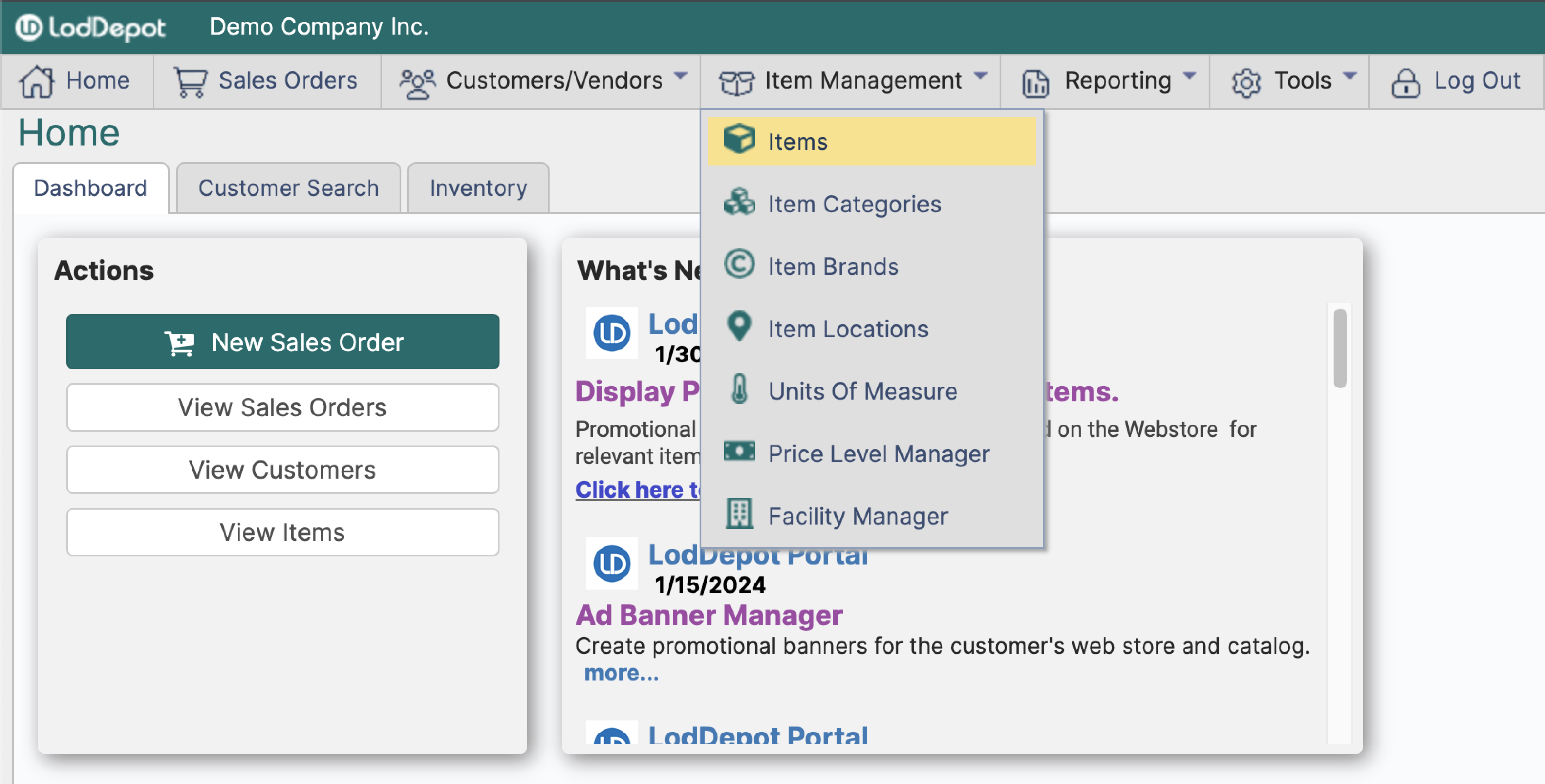
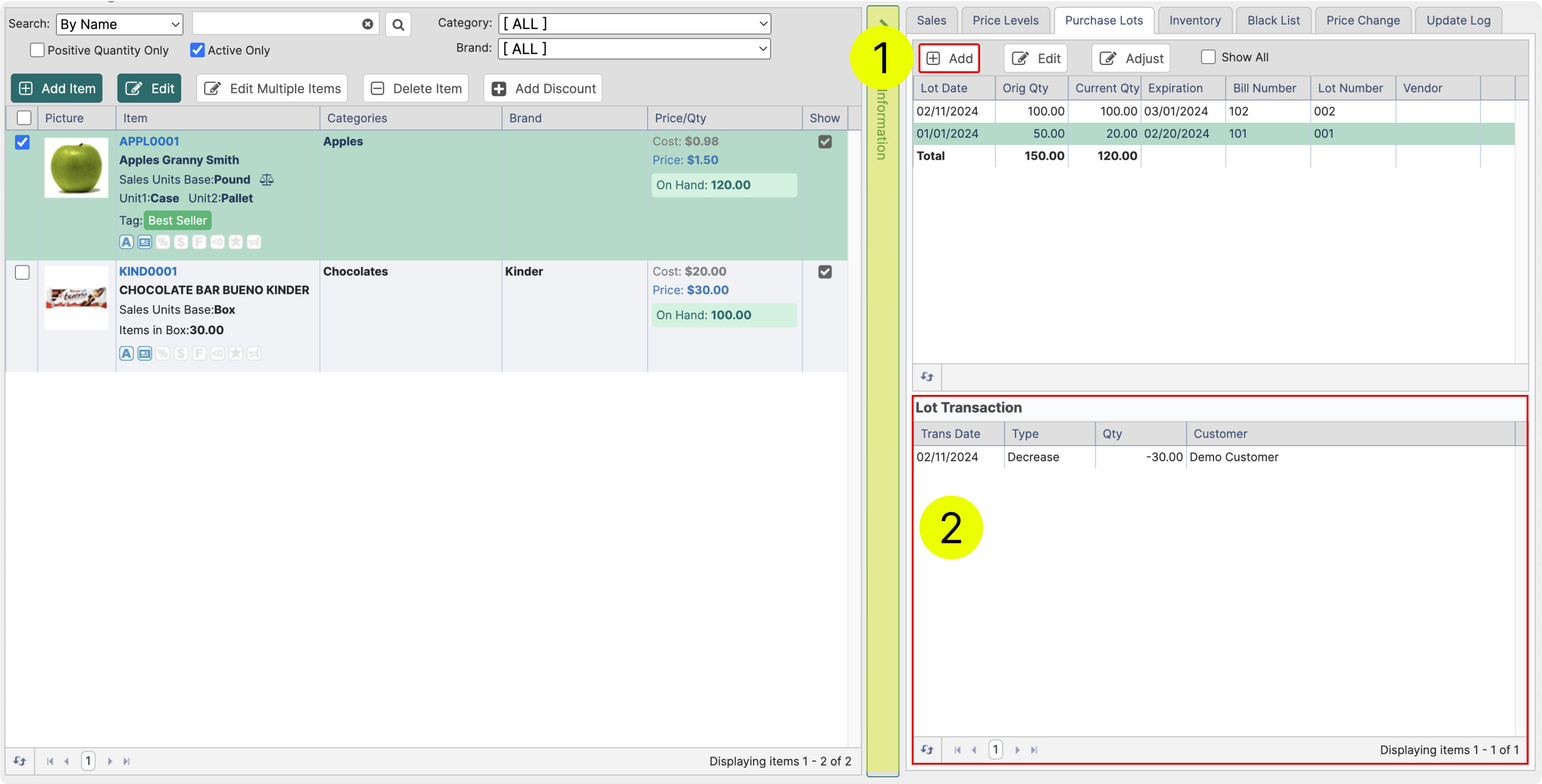
One of the ways to manage your inventory in LodDepot is by using Item Lots. Select an item and click More Information to access the Item Lots tool.
- Click add to create a new purchase lot
- Select one of the Purchase Lots to see all transactions with that purchase lot.
¶ Creating an Item Lot
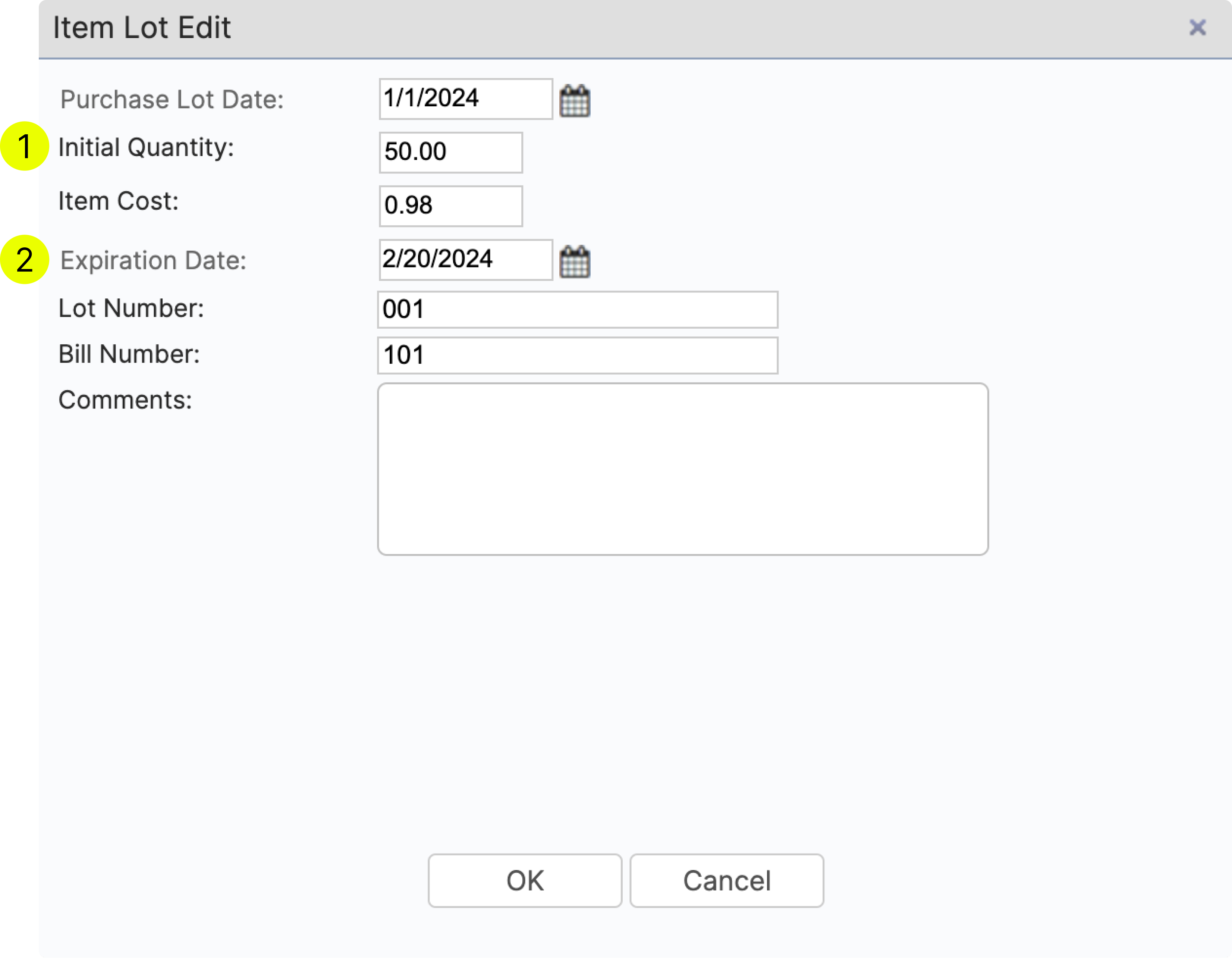
- Enter the Quantity purchased/added
- LodDepot allows you to set an expiration date and track the remaining quantity for each of the expiration date. When you do a sale, LodDepot will automatically deduct the quantity purchased from the lot with the nearest expiry date
¶ Making Adjustments to Item Lots
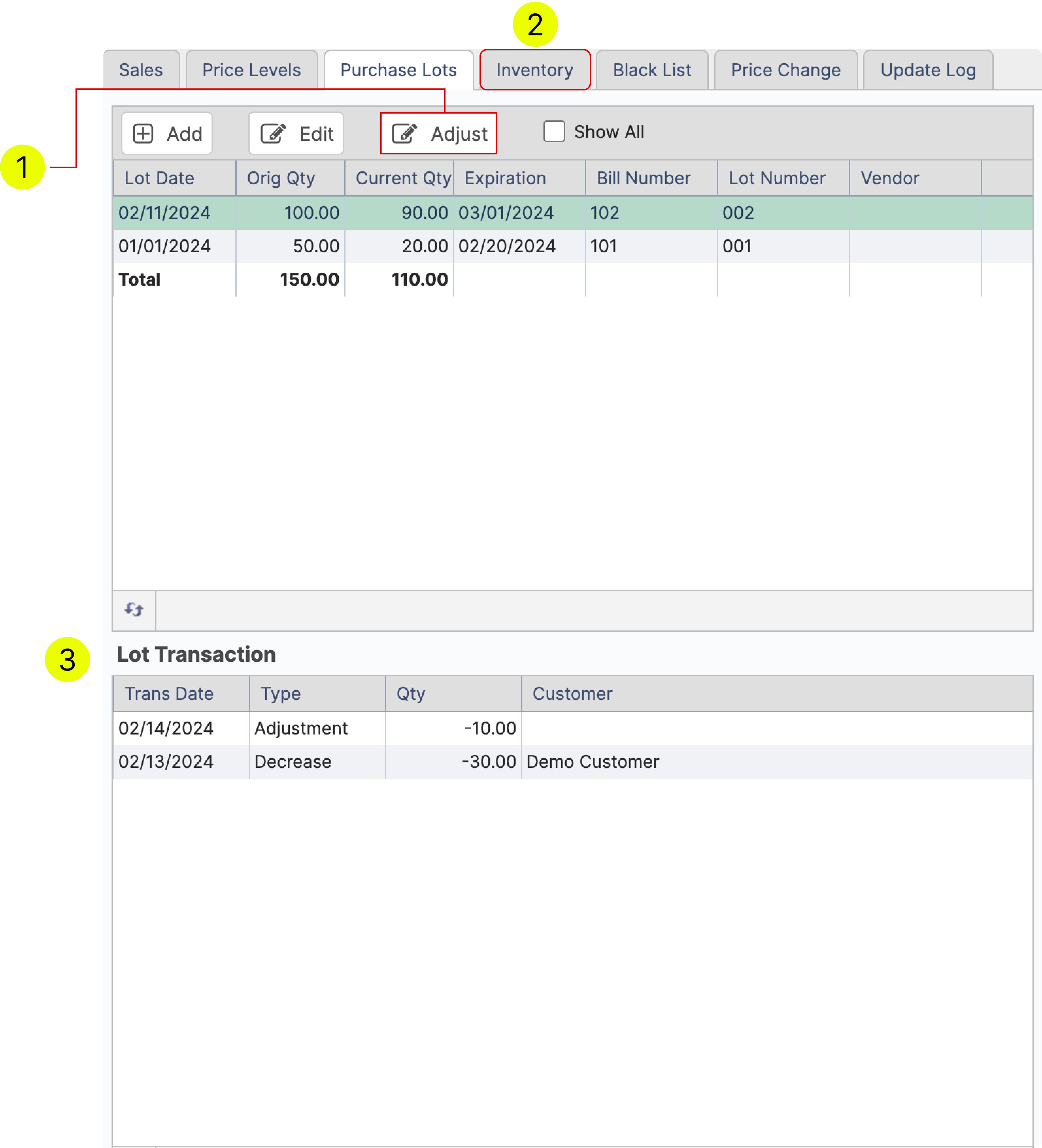
- Adjustment : Firstly, click on a lot that you want to adjust, then click adjust. Set the current quantity of that lot and the current quantity will adjust automatically.
- Item Transactions: To view all transactions with an item, regardless of the lot, navigate to the Inventory Tab.
- Lot Transactions: When you have a lot selected, all transactions with this lot will appear here.
¶ Location Management
Location Management is the optional bin location system for companies that store stock in defined places. It is turned on in Settings, Features, section Warehouse Locations, with the option Enable Location Management (Facilities, Areas, Locations). Nothing changes for companies that leave it off.
Stock is organized in three levels:
- Facility - a physical site such as a building or a yard, maintained in Facility Manager. Each facility has a short Facility Code, for example NJ.
- Area - a zone inside a facility, such as a rack block, a cooler, or a shipping lane. An area has a short Area Code, for example A1, and can have its own label printer and its own pick ticket printer.
- Location - the bin itself, built from up to four segments: Row, Bay, Level, and Position.
The location code always starts with the area code, for example A1-01-03-05, and the scannable barcode adds the facility code in front, for example NJ-A1-01-03-05, so one scan is unique across every facility.
¶ Setting up areas and locations
- Open Item Management, Location Management. The left panel lists the areas; add an area with its code and name, and optionally the network address of the Zebra label printer standing in that area.
- With an area selected, add locations on the right. Enter the segments and the location code and barcode are generated automatically. Choose a Location Type (Storage, Receiving, Pick, Bulk, Staging, Shipping, Returns, Damaged) and, if you want, a Label Color.
- Use Bulk Create Locations under the More button to generate a whole rack from segment ranges, for example Rows 01 to 10, Bays 01 to 20, Levels 01 to 04. Locations that already exist are skipped.
- Select locations with the checkboxes and choose Print Labels under the More button to print their barcode labels.
The label color is used for the location chips shown on the picking screens, the item details, and the item photo screen in the mobile app, so frequently used zones such as cold storage or a returns lane are recognizable at a glance. Locations without a color use a black chip.
¶ Assigning items to locations
In the Portal, open the item and use the Locations tab to add one or more locations. In the mobile app, open Item Management, find the item and open its edit screen, then add a location either by choosing it from the searchable list or by scanning the location's barcode label. Items Lookup shows the assigned locations but does not change them.
¶ Quantities per location
Every location assignment carries the quantity of that item currently in that location. Quantities are never changed blindly: each change is written as a transaction and the quantity shown is recalculated from those transactions, so every figure can be traced back to what caused it. Quantities change when stock is moved between locations, when a pallet is broken down into a location, and - if the setting below is on - when ordinary inventory transactions are posted.
To move stock, select the location on the item's Locations tab and choose Move, then pick the destination location and enter the quantity. The quantity is subtracted from the source and added to the destination, and both sides are recorded.
The setting Update Locations from Inventory Transactions (Settings, Features, Warehouse Locations) also posts every inventory transaction to the item's primary location in the facility of that transaction, so receiving, picking, and adjustments keep location quantities up to date without extra steps.
¶ What pickers see
When Location Management is on, picking tickets, the picking screens, item details, and item search show the item's assigned locations instead of the old free text location field. In the mobile app each location is a separate colored chip; tapping a chip on a picking line shows the location code in large text so it can be read at arm's length. Items with no location assignment show no location at all, which makes missing assignments easy to spot.
¶ Pallet Management
A pallet, also called an LPN or license plate, identifies one physical handling unit: a pallet, carton, or tote. LodDepot generates a unique number for it, for example LPN00000001, and a barcode label that stays with the unit for its whole life. The pallet's current location is stored on the pallet, so moving it is one scan - the number and the label never change. A pallet holds one or many items with their quantities and has a status such as Active, Breakdown, or Closed.
¶ Turning pallet tracking on
- Turn on Location Management first; pallets always stand in a location.
- In Settings, Features, Warehouse Locations, check Enable Pallet Tracking and save.
- Optionally set the Pallet ID Number Template, for example LPN{00000000} or PLT-{000000}. It applies to new pallets only.
The Pallets screen then appears in the Item Management menu, the item screen gets a Pallets tab, and the Pallets screen appears in the mobile app.
¶ Working with pallets in the Portal
- Open Item Management, Pallets.
- New Pallet creates a pallet at the location you pick; the number is generated for you.
- Add Item and Remove Item maintain the pallet contents, each item with its quantity and unit.
- Edit and Move change the pallet's location; the number, barcode, and contents stay the same.
- View Label opens the label as a PDF and Print Label sends it to the printer.
- Delete removes an empty pallet.
The pallet list shows the pallet ID, its area and location, its status, the number of items on it, and the date it was created.
¶ Breaking a pallet down
Breakdown moves stock from the pallet into storage locations. Each item on the pallet is listed with the quantity you are taking off and the location it goes to; the location the item is already assigned to is suggested automatically, so most breakdowns are just a confirmation. A location must be chosen for every line that has a quantity, and lines left at zero are ignored. After confirming, the quantities leave the pallet and arrive in the locations, both sides are recorded, and the pallet status is updated automatically: partly emptied pallets become Breakdown and fully emptied ones are closed.
¶ Working with pallets in the mobile app
- Open Pallets from the home screen; it sits directly after Items Lookup.
- Find a pallet by typing part of its number or an item name in the search bar, or scan the pallet barcode with the scanner button at the bottom of the screen. The button next to the search bar switches scanning to pallet search.
- The pallet card shows the pallet ID, its location, and its status on one line, with the pallet contents below.
- The action buttons under the card are Move (pick a location or scan it), Breakdown, Print, Status, and Delete. Items can be added and removed on the same screen.
- New Pallet is at the top of the screen: pick or scan the location, confirm it in the dialog, and the pallet is created.
Items Lookup shows which pallets hold a scanned item, together with their locations, but pallets are managed only on the Pallets screen. The mobile features described here require app version 0.4.94 or later.
¶ Label printing
Barcode labels are printed on the Zebra (ZPL) label printer of the area, so a label is always printed where the work happens. PDF labels are printed on the area's pick ticket printer, or on the Windows default printer if none is set.
If the Portal runs in the cloud, or the browser cannot reach the warehouse printer, labels can go through a print queue: check Enable Label Printing from Portal (Settings, Features, Warehouse Locations) and the LodDepot Sync application running on a computer in the warehouse picks each label up and prints it. Check Print Mobile Labels Through the Print Queue to do the same for labels printed from the mobile app. The Print Queue screen in the Item Management menu lists every queued label with the date and time it was created, its status, and the printer it was sent to.
The label itself is configured with Pallet Label Size (4x6, 4x4, 4x3, 4x2, or 4x1 inches), Pallet Label Format (ZPL), and Pallet Label Content - a list of placeholders, one per line, printed from the top of the label down:
- {lpnCode} - the pallet number
- {barcode} - the pallet barcode
- {locationCode} and {locationBarcode} - the location code, and the location barcode printed as a scannable barcode
- {facilityCode}, {areaCode}, {areaName} - the facility and area of the pallet
- {itemName}, {itemDescription} - the first item on the pallet
- {itemNames}, {itemDescriptions} - all items, comma separated
- {itemList} - one item per line
- {itemListQty} - one item per line with the quantity currently on the pallet and its unit
- {itemCount} - the number of different items on the pallet
- {created} - the date the pallet was created
Lines can mix plain text and placeholders, for example Pallet {lpnCode} created {created}. Leaving the content empty prints the standard label: pallet number, pallet barcode, item list with quantities, and the location barcode.